
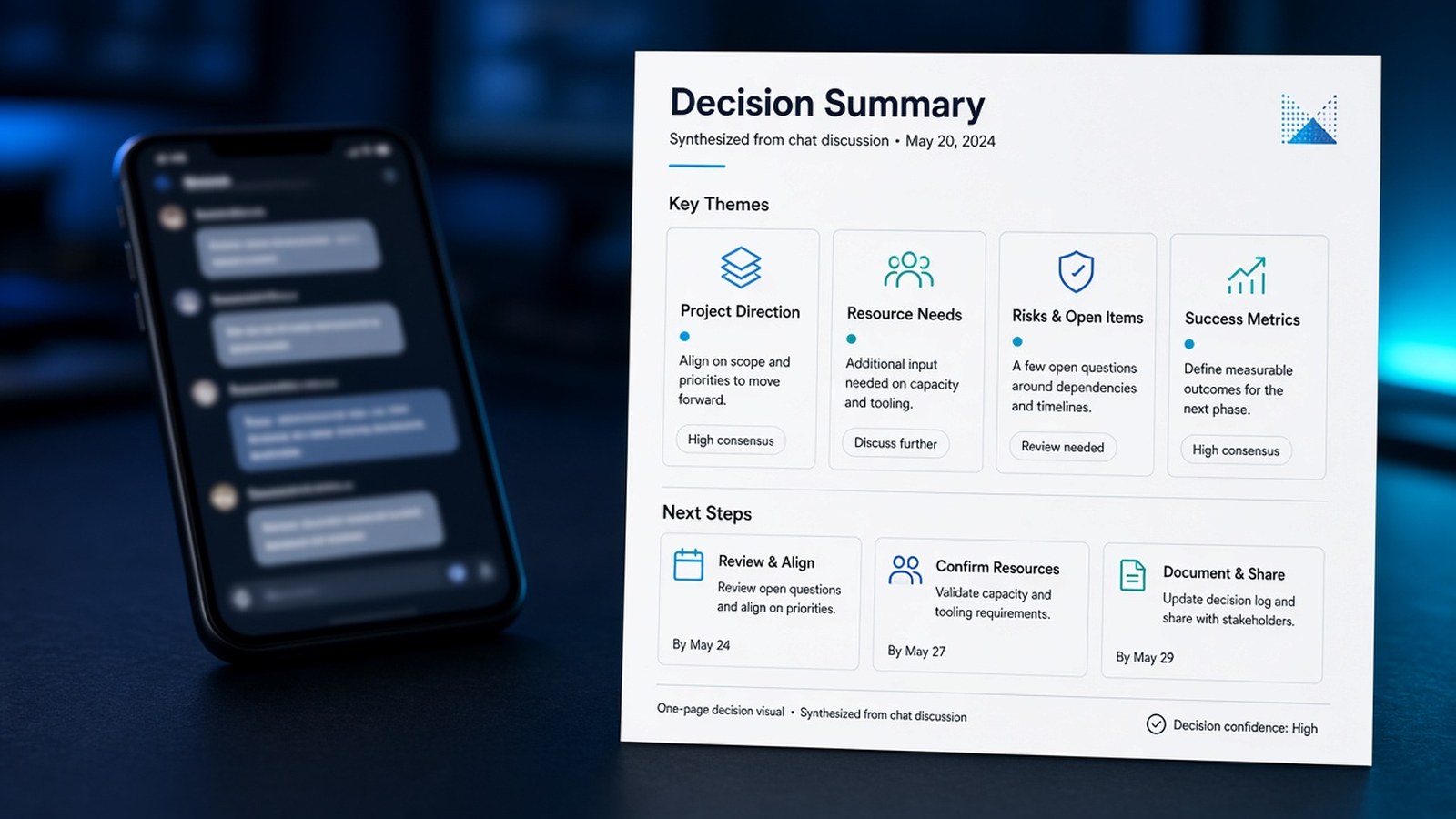
Most AI chats die in Slack as walls of text. Someone pastes a long model reply, a few people react with an emoji, and the thread goes cold. The adoption unlock is not a smarter prompt in private. It is turning unfiltered thoughts into a one-page visual—themes plus next steps—that a team can actually share and act on. That is the ChatGPT → Gamma workflow professionals are building in public right now, and it is a practical pattern for generative AI for business workflows.
Why chat dumps fail as team communication
ChatGPT is excellent at thinking with you. It is a weak default format for deciding with others.
A dump into Slack or Teams usually fails for boring reasons: nobody can skim 1,200 words on a phone; themes, risks, and owners stay buried; "what do we do next?" never becomes a visible list; and managers re-ask questions the chat already answered—badly formatted.
That is not a model failure. It is a packaging failure. AI adoption stalls when the tool's output cannot travel through the organization without a translator.
What the ChatGPT → Gamma trend is actually teaching
In early September 2026, an X News cluster highlighted professionals turning ChatGPT chats into actionable visuals. The circulating pattern—often associated with a workflow shared by Maan—captures unfiltered ideas, uses targeted prompts to pull themes and next steps, then links ChatGPT to Gamma for a clean visual summary. Reaction in the cluster praised prompts that focus on what to ignore, not only what to keep.
Treat that cluster as a practitioner signal—not peer-reviewed research for every product claim in the trend story. The lesson holds: shareable decision pages beat clever private chats. Gamma connectors and codes like /Blueprint or /Flowchart (as summarized there) are accelerators; the habit matters more than the slide-tool brand. Keep the pipeline even if you use another one-pager: dump → extract → one page.
The three-step workflow (dump → themes → decision page)
Here is the version I teach in corporate AI training. It takes minutes once the muscle memory exists.
1. Dump raw thoughts into ChatGPT
Do not polish first. Paste notes, meeting scraps, half-formed strategy—whatever is clogging your head. Tell the model the audience and the decision you need this week. Unfiltered input is a feature. The chat is a scratchpad, not the deliverable.
2. Extract themes and next steps—on purpose
Ask for a tight extraction, not another essay:
- 3–5 themes (short phrase each)
- Next steps with suggested owner role and rough timing
- Risks / open questions called out separately
- Explicitly ignore tangents and anything that does not change a decision this week
That "what to ignore" line is the difference between a useful brief and another wall of text.
3. Send the brief to Gamma for a one-page visual
Paste the extracted outline into Gamma (or connect ChatGPT → Gamma if your stack supports it). Aim for one page: title, themes, next steps, owners. Blueprint/flowchart for sequences; simple cards for prioritization. Share that in Slack—not the raw chat. The chat stays for the author; the decision page is for the team.
The oversight tax is why walls of text feel "productive"
A related X News cluster amplified a harder truth: time "saved" often returns as oversight. Summaries around the Glean Work AI Index 2026 described knowledge workers saving about 11 hours weekly while losing roughly 6.4 to editing, re-explaining, and supervising AI—nearly 60% of the savings eaten by managing the machine. Survey chatter in the same cluster (Orgvue, Forrester, Robert Half as summarized on X) pointed to leaders regretting blunt "replace people with AI" cuts.
This is not an anti-automation argument. Dumping half-digested AI text into the team channel recreates the oversight tax: people become editors of each other's chat dumps. A one-page decision visual cuts re-explanation because themes and next steps are the interface.
Enterprises are staffing for outcomes—your team can start with a page
Macro context helps. Another X News cluster covered Google Cloud and Accenture launching a Gemini Enterprise Business Group—up to about 1,000 engineers trained by Google Cloud to work on-site with clients and turn AI pilots into scaled results. The YouTube example cited in that summary claimed an 11% lift in NFL Sunday Ticket customer sentiment and a 37% cut in handle times—figures from the circulating story, not independent Synthetic Echo audits.
You do not need a thousand forward-deployed engineers to learn the SMB lesson: pilots become outcomes when someone owns the path from tool output to shared work artifact. For most teams that path starts as ChatGPT → themes → Gamma one-pager → Slack/Teams decision thread.
Make the decision page the default, not the chat
If you want this to stick as AI adoption, change the social contract—not just the personal habit:
| Old default | New default |
|---|---|
| Paste the full ChatGPT reply | Paste a one-page visual + link to source chat if needed |
| "Thoughts?" under a wall of text | "Approve / adjust these next steps" |
| Quality = who prompts best | Quality = can the team decide from the page? |
| Training = prompt tricks | Training = dump → extract → shareable artifact |
Run it for two weeks on real work—priorities, briefs, post-mortems, pipeline reviews. Kill unread walls. Update standing instructions so ChatGPT defaults to themes + next steps + ignore-list before you open Gamma. That is generative AI for business workflows as habit: the model helps you think; the page helps the team move.
Soft next step
If your org already bought the seats and still watches AI die in Slack threads, the gap is usually packaging and ownership—not another model upgrade. I am Nathan Graham, founder of Synthetic Echo—based in Toronto · serving Canada & North America. I offer a free discovery call to map where chat dumps are stalling decisions and which workflows should become one-page visual defaults first. This is a prioritization conversation, not a free full audit.
Tired of AI dying in Slack threads?
Nathan Graham helps teams turn chat dumps into shareable decision pages—and train the habit so generative AI for business workflows actually sticks.
FAQ
Frequently asked questions
Why do ChatGPT dumps fail in Slack?
Walls of text are hard to skim on a phone; themes, risks, and owners stay buried; next steps never become a visible list; and managers re-ask questions the chat already answered. That is a packaging failure, not a model failure.
Do we have to use Gamma?
No. Gamma connectors and codes like /Blueprint or /Flowchart are accelerators. Keep the pipeline even with another one-pager: dump → extract → one page. The habit matters more than the slide-tool brand.
What is the oversight tax?
Time "saved" often returns as editing, re-explaining, and supervising AI. Dumping half-digested AI text into the team channel recreates that tax. A one-page decision visual cuts re-explanation because themes and next steps are the interface.
What should I do next?
Book a free discovery call to map where chat dumps are stalling decisions and which workflows should become one-page visual defaults first. It is a prioritization conversation, not a free full audit.