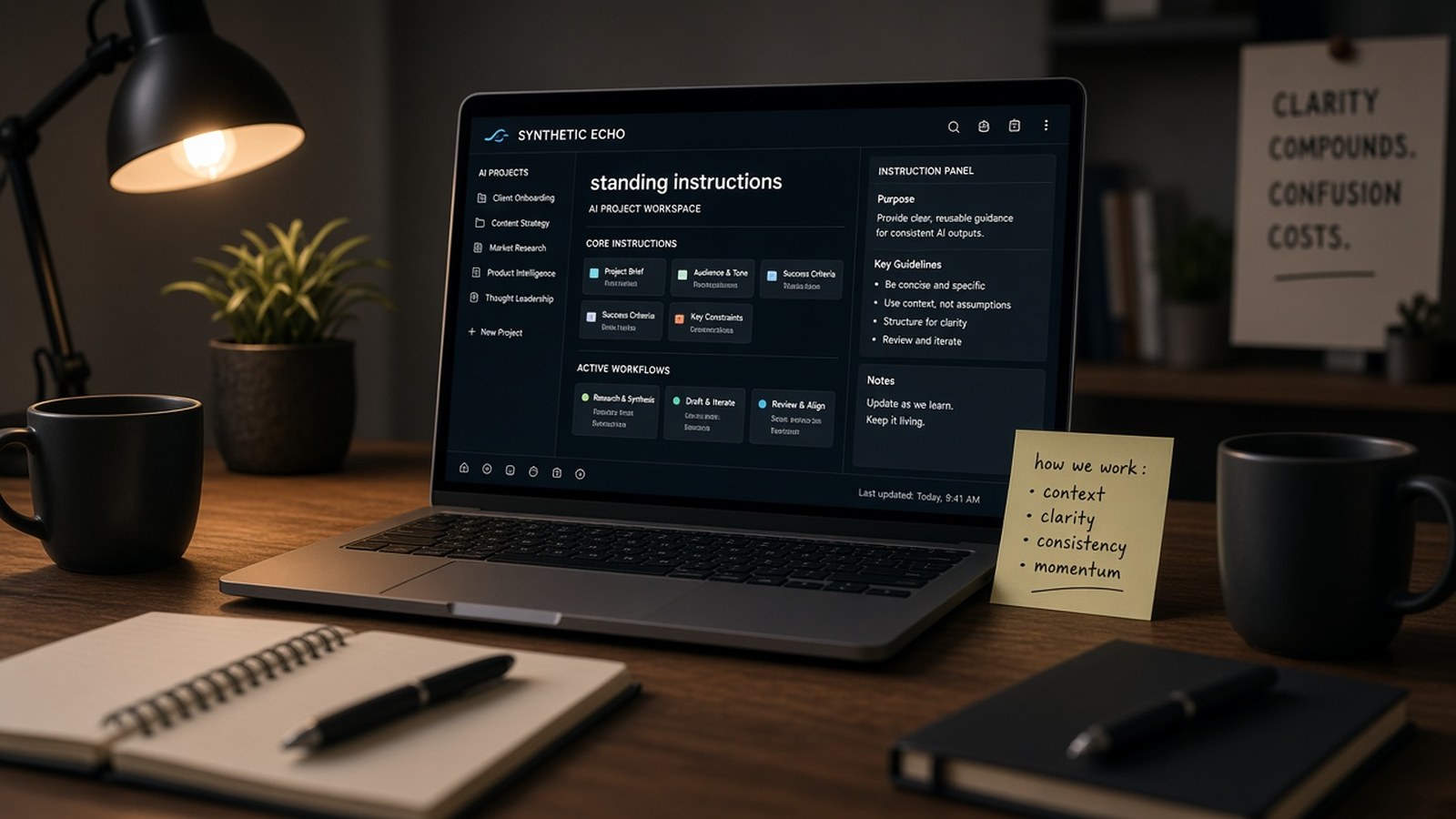
North American teams don't fail at generative AI because they lack a clever prompt—they fail because every chat starts from zero. The shift around Claude Projects, CLAUDE.md, Cursor rules, ChatGPT Projects, and "prompt-free" product design is really about standing instructions: encode how your business works once, then use short task prompts on top. That's the difference between buying seats and achieving AI adoption—and what corporate AI training should teach for real generative AI for business workflows.
The chatbot habit that's quietly failing your team
Open a blank box. Paste the brand voice. Paste the client context. Paste the disclaimer language. Ask for the draft. Close the tab. Tomorrow, do it again.
That loop feels productive because something comes back fast. It is also why quality drifts by person, why brand tone never sticks, and why managers quietly stop trusting the tools they paid for.
Seat licenses without shared context are not AI adoption. They are a subscription to everyone improvising differently—style guides retyped, compliance lines skipped, personas invented. The model is not the problem. Starting from zero every session is. If your team still treats ChatGPT, Claude, or Copilot like a stranger who needs a full briefing each time, you are paying a repeat tax on every workflow that matters.
What "no prompting" actually means
You will hear shorthand online—"prompt-free," "death of the prompt box," "stop prompting like a chatbot." Treat that as circulating language, not a single viral origin story. The useful idea underneath is simpler.
It is not magic. It is not "never type anything." Short task prompts still matter: the outcome, the audience, the deadline, the acceptance criteria. What is fading is the habit of rebuilding your company's operating context from scratch in every conversation.
In Andreessen Horowitz's Big Ideas 2026 thesis, Marc Andrusko argues mainstream users will see less of an empty prompt box and more apps that act from context and intent—suggest a refactor, draft the follow-up, propose variants—for people to review. That maps to how teams want to run generative AI for business workflows: orient once, then ask for the next useful move.
Standing instructions are the business version of that shift. Tell the system who you are, who you serve, how you sound, what you never do, and which documents are canonical—so every new chat starts already oriented.
The stack business teams can use this week
You do not need a custom platform to start. The major tools already support the pattern.
Claude Projects (claude.ai) are workspaces with their own knowledge bases and project instructions that tailor Claude across chats in that project. On Team and Enterprise, projects can be shared so the brief is not trapped in one person's account. Set instructions once; upload the docs that should travel with every conversation. Chat history alone is not shared context—project knowledge and instructions are.
ChatGPT Projects do the same on OpenAI's side: chats, files, and custom instructions for repeated workstreams. Business and Enterprise can treat a shared project as a live context hub instead of a private prompt graveyard.
For builders, use version-controlled memory: a CLAUDE.md Claude auto-reads at session start, plus Cursor Rules / AGENTS.md, so the whole engineering team gets the same agent behavior without re-attaching a briefing every Monday.
Concrete marketing example: a "Brand & campaigns" Project with the brand kit, messaging pillars, and a "never invent claims" rule. Instructions: match our voice, cite sources for factual claims, flag legal review items, use Canadian spelling for external copy. Staff then ask for a landing-page outline or LinkedIn draft—not a re-upload of the brand bible. Same pattern for sales, operations, or finance. The tool changes; the habit does not.
Tools aren't training—standing instructions are the curriculum
Buying Claude, ChatGPT, or Copilot seats does not create consistent output. Most organizations stall at "everyone chats differently"—uneven quality, brand drift, quiet abandonment after the demo glow fades.
That is why corporate AI training should not stop at parlor tricks for clever wording. Prompt engineering is not "dead"—it is shifting toward context and workflow design: what lives in project instructions vs. knowledge files, when to clear a chat, and when to update standing memory because the model got the same thing wrong twice.
Anthropic's CLAUDE.md guidance is a briefing for a new teammate—commit it so the team stops re-explaining conventions, and pair it with outcome-focused prompts. Treat those files as living docs. If the model keeps missing your tone or process, fix the shared brief—not another heroic one-off prompt from the person who "gets AI."
A useful training curriculum looks like this:
- Audit the repeat tax — What do staff retype weekly (tone, disclaimers, templates, compliance language)?
- Encode it once — Project instructions + knowledge files; engineering adds CLAUDE.md / Cursor rules.
- Train the operating system — Outcomes, acceptance criteria, clear vs. update memory.
- Govern — Who can edit shared instructions? What is client-confidential vs. org-wide?
- Measure adoption — Consistency of outputs and time-to-first-good-draft, not "number of prompts."
| One-off chatbot habit | Standing-instructions habit |
|---|---|
| Re-paste brand/SOP every time | Project instructions / CLAUDE.md / Rules once |
| Context lives in one person's head | Shared Project knowledge or version-controlled rules |
| Quality depends on who prompts | Quality depends on the shared brief + light task prompts |
| Training = "here's ChatGPT" | Training = how to design Projects, memory, and workflows |
A simple 30-day adoption play
You do not need a year-long program to prove the point. For Canadian and North American teams rolling out AI this quarter, a tight 30-day loop works:
Week 1 — Pick the tax. Choose one or two high-repeat workflows. List every scrap of context people paste or keep in their heads.
Week 2 — Build the Project. Write project instructions. Upload five to ten current knowledge files. Assign an owner. Engineers can mirror the same conventions in CLAUDE.md or Cursor rules.
Week 3 — Train the team on using it. Short prompts, clear outcomes, when to start fresh vs. update standing memory. Show bad vs. good drafts from the same Project.
Week 4 — Review and prune. Kill stale instructions. Tighten the never-do list. Graduate what works from "pilot" to "how we work here." Measure rewrite effort on first drafts—not prompt count.
That is AI adoption as an operating habit, not a tool launch email.
Soft next step
If your org already bought the seats and still feels stuck in chatbot mode, the gap is usually not another model—it is shared context, ownership, and training that teaches Projects and workflows instead of one-off prompting.
I run a free discovery call for teams that want to map which workflows deserve standing instructions first, and how corporate AI training can lock in AI adoption without another unused chatbot rollout.
Still starting every chat from zero?
Nathan Graham helps teams encode standing instructions—Projects, CLAUDE.md, rules—and train people so AI adoption sticks beyond the demo.
FAQ
Frequently asked questions
Does "no prompting" mean never typing anything?
No. Short task prompts still matter: outcome, audience, deadline, acceptance criteria. What fades is rebuilding your company's operating context from scratch in every conversation.
Which tools support standing instructions this week?
Claude Projects and ChatGPT Projects for shared instructions plus knowledge files; for builders, CLAUDE.md, Cursor Rules, and AGENTS.md as version-controlled memory so the whole team gets the same agent behavior.
What should corporate AI training teach instead of parlor tricks?
Context and workflow design—what lives in project instructions vs knowledge files, when to clear a chat, when to update standing memory, who can edit shared briefs, and measuring consistency and time-to-first-good-draft—not prompt count.
What should I do next?
Book a free discovery call to map which workflows deserve standing instructions first and how corporate AI training can lock in AI adoption without another unused chatbot rollout.