Every Monday someone exports a CSV, pastes half of it into ChatGPT, and asks for "quick insights." The reply looks smart. The numbers are already stale. By Wednesday the sheet has moved, the paste is wrong, and nobody trusts the chart that made it into Slack.
AI adoption does not stall because your team cannot write prompts. It stalls because the model is guessing from a dump instead of reading live sources. For SMEs building generative AI for business workflows, the upgrade is simple: connect live data once, ask in plain English, then share a dashboard—not another spreadsheet screenshot.
Spreadsheet pastes feel productive. They rot trust.
Pasting a sheet into chat is the modern version of emailing Excel as the system of record. It feels fast. It creates three quiet failures:
- Stale truth. Yesterday's export is not today's pipeline, inventory, or cash position.
- Silent truncation. Large tables get clipped, summarized, or half-remembered by the model. You do not always see what was dropped.
- Unsharable risk. A clever private answer is not a team artifact. Managers re-ask the same question against different pastes and get different "truths."
That is not a model problem. It is a connection problem. Seat licenses without a live path to data are still improvisation with better grammar.
What OpenAI's Data agent signal is actually saying
In mid-September 2026, an X News cluster on OpenAI's Data agent for ChatGPT Work framed the shift clearly: connect warehouse and file sources—Amazon Redshift, Google BigQuery, Snowflake, plus Google Drive, Dropbox, Box, and SharePoint—then query in natural language to build interactive dashboards and follow-on actions while respecting existing permissions. Circulating summaries also note Tableau / Datadog-style paths and internal OpenAI use for quick analyses.
Treat that as a practitioner product signal—not peer-reviewed research for every attributed detail. The durable SME lesson is the workflow shape, not the press kit: warehouse + Drive/SharePoint → plain-English questions → shareable dashboard, instead of CSV dumps into chat.
A lighter enterprise echo showed up the same week in an X News cluster on ChatGPT for Financial Services: premium connected data, citations, and secure outputs for analyst-style work. You do not need a bank desk to take the SMB lesson—trust rises when answers are grounded in governed sources, not pasted fragments.
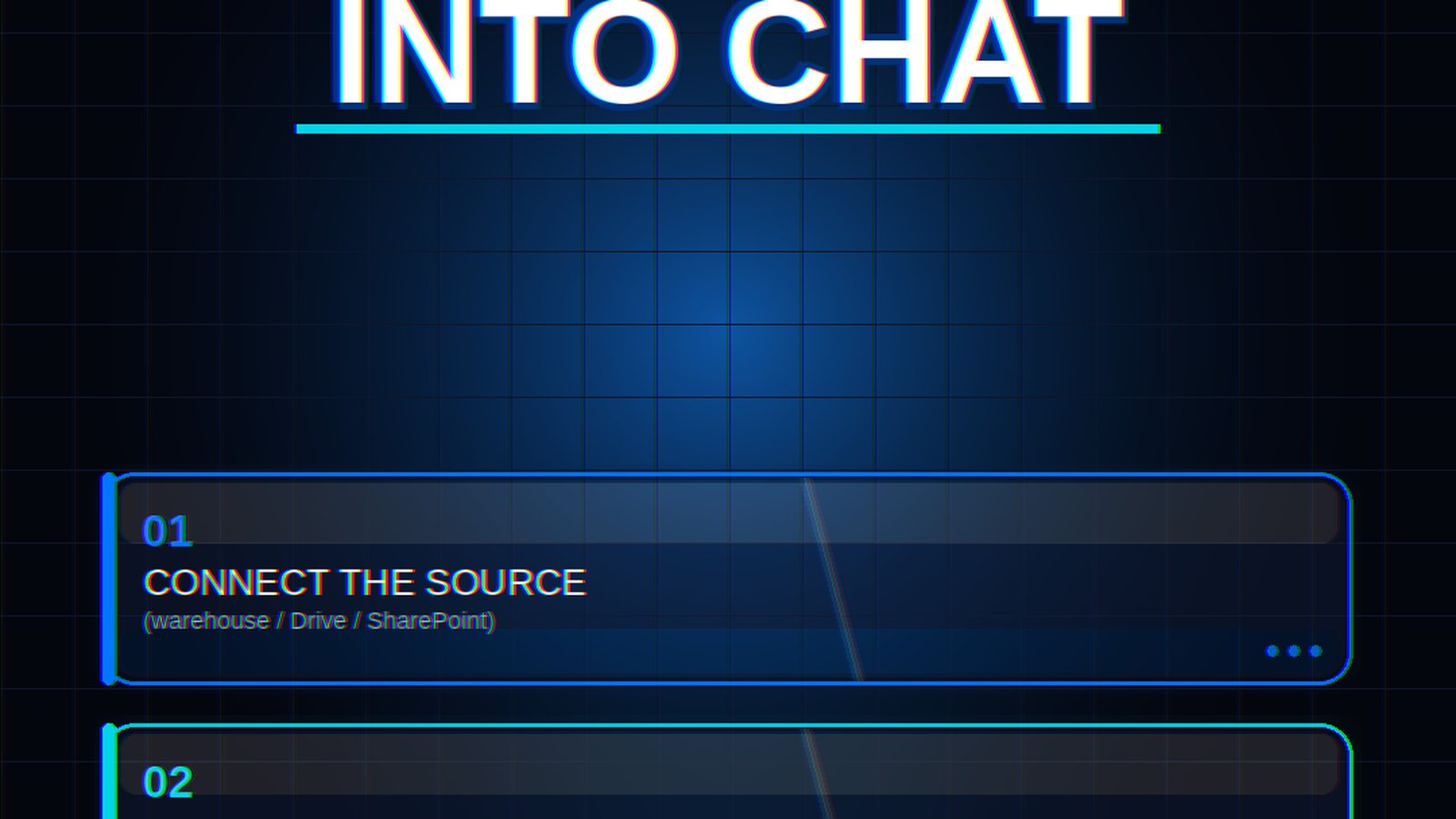
The three-step workflow (connect → ask → share)
Here is the version I teach in corporate AI training. Keep it narrow enough that ops, sales, or finance can run it this month without a six-month data lake program.
1. Connect the source (once)
Pick the systems that already hold truth: a warehouse table or semantic layer if you have one; otherwise the shared Drive / SharePoint folders that actually run the business. Prefer least privilege. Admin enables the connector; users do not each paste their own private copies.
Do not connect "everything for magic." Connect the one dataset that answers the weekly question your team already fights about—pipeline by stage, aging AR, inventory turns, campaign spend vs. booked revenue.
2. Ask in plain English
Once the source is live, stop exporting. Ask the question the meeting actually needs:
- "Which open opportunities slipped stage this week vs. last?"
- "Where did margin drop more than 3 points by SKU family?"
- "What is still unpaid past 45 days, grouped by owner?"
Refine in the same thread. The point of a Data-agent-style loop is iteration against live numbers—not a one-shot essay on a dead CSV.
3. Share the dashboard
The chat is for the analyst. The deliverable for the team is the interactive view—or the link into Tableau / Power BI / whatever your org already trusts. Put that in Slack or Teams with one decision ask: approve, adjust, or escalate.
Teams adopt AI when it reads live numbers—not when it guesses from a paste.
| Old habit | Live-data habit |
|---|---|
| Export → paste → hope | Connect source once with permissions |
| "Insights from this CSV" | Plain-English questions on current tables |
| Screenshot the chat answer | Share an interactive dashboard / BI link |
| Different pastes, different truths | One governed source, many readers |
| Training = clever prompts | Training = connect → ask → share |
Why SMEs win when they stop shipping CSV dumps
Large enterprises can staff analysts to babysit every export. Most SMEs cannot. You need one path where a sales lead, ops manager, or finance partner can ask a real question without waiting three days—and without inventing numbers from a truncated paste.
Live connection also shrinks the oversight tax. When everyone argues about which file is current, "AI time savings" return as reconciliation. When the agent reads the same warehouse or SharePoint the company already trusts, review focuses on judgment—not which tab someone uploaded at 7:41 a.m.
You do not need every Redshift and Snowflake logo on day one. Start with the file store or warehouse slice you already have. The ChatGPT Work / Data agent pattern is the shape: connect, ask, share—even if your BI layer or connector brand changes tomorrow.
A two-week live-data sprint (narrow on purpose)
Week 1 — Name one recurring question. High volume, visible argument, currently "solved" by spreadsheet paste. Name the owner and the canonical source.
Week 2 — Connect and replace the paste. Wire the source with least privilege. Write three standing questions the team can reuse. Publish one dashboard link as the only allowed share for that topic. Kill the "just paste the sheet" default in the channel rules.
Measure rewrite effort and "which number is right?" threads—not how clever the private chat sounded.
Soft next step
If your organization already bought ChatGPT seats and still runs Monday by CSV dump, the gap is usually connection and packaging—not another model upgrade. I am Nathan Graham, founder of Synthetic Echo—Toronto-based · serving Canada & North America. I offer a free discovery call to map which live-data workflow deserves the connect → ask → share path first, and how corporate AI training can lock in AI adoption without another paste-and-pray loop. This is a prioritization conversation, not a free full audit.
Still pasting CSVs into ChatGPT?
Nathan Graham helps SMEs connect live data once—warehouse, Drive, SharePoint—so generative AI for business workflows answers from governed sources, not stale dumps.
Frequently asked questions
Why do spreadsheet pastes into ChatGPT fail?
Yesterday's export is already stale; large tables get clipped or half-remembered; and a clever private answer is not a team artifact—managers re-ask the same question against different pastes and get different 'truths.'
Do we need Redshift or Snowflake on day one?
No. Start with the file store or warehouse slice you already have. The durable lesson is warehouse + Drive/SharePoint → plain-English questions → shareable dashboard—even if your BI layer or connector brand changes tomorrow.
What should corporate AI training teach instead of clever prompts?
Connect → ask → share. Wire one governed source with least privilege, write standing questions the team can reuse, and publish one dashboard link as the only allowed share for that topic.
What should I do next?
Book a free discovery call to map which live-data workflow deserves the connect → ask → share path first. It is a prioritization conversation, not a free full audit.