Every Friday someone screenshots a pipeline board, pastes it into an AI chat, and asks for “quick deal risk.” The reply looks sharp. The stage flags are already wrong. By Monday the opportunity moved, the paste is stale, and nobody trusts the coaching note that made it into Slack.
AI adoption does not stall because sales teams cannot write prompts. It stalls because deals live in the CRM while the AI lives in another tab—fed by screenshots, exports, and half-remembered account history. For SMEs building generative AI for business workflows, the durable upgrade is blunt: put CRM context inside the AI workspace. Connect the CRM, ask in plain English, run the sales skill—so coaching happens against live pipeline, not a picture of it.
Pipeline screenshots feel like “using AI.” They rot trust.
A CRM screenshot looks responsible. You “shared context.” You can tell leadership the team is experimenting with Claude or ChatGPT on deals.
What actually happens: stages drift between capture and answer; closed-lost reasons never make the crop; the model invents stakeholders from a blurry Kanban; managers re-ask the same forecast against different pastes and get different “truths.” The curious AE adopts the story of AI. The rest of the floor keeps living in the CRM and treats chat as theater.
Seat licenses plus clipboard CRM are not adoption. They are a second workplace that only opens when someone has time to crop a board.
Distinct from Tip 06 (live data / CSV—stop pasting spreadsheets) and Tip 08 (in-app Copilot in Office—finish where the file lives): Tip 11 is the sales sibling—bring accounts, opportunities, and forecasts into the AI chat so sellers do not leave the assistant to “check the CRM,” or leave the CRM to “ask the AI.”
What the Dreamforce CRM-in-Claude signal is actually saying
On September 15–16, 2026, X News clusters on Salesforce integrating CRM into Claude at Dreamforce and the related Benioff–Amodei / AIforce conversation spiked as the morning’s strongest broad B2B workflow story—our research brief counted roughly ~4.6k related posts (Sep 15 ~1.36k; Sep 16 AM already ~827). Circulating summaries describe a beta path that embeds accounts, opportunities, forecasts, and ~37 sales skills into Claude so sellers can prep calls, review deals, and draft CRM updates without app-switching—under existing permissions, with write-backs that typically wait for human approval.
Treat that as a practitioner product signal—not peer-reviewed research for every detail, and not a ranking of which CRM or model “wins.” Anthropic’s Salesforce in Claude framing matches the shape: admin connects once; sellers work under CRM permissions; skills cover briefings, research, call prep, pipeline review, and CRM updates. The durable SME lesson is the workflow: CRM → plain-English questions → sales skills with governed actions, instead of screenshot → chat → hope.
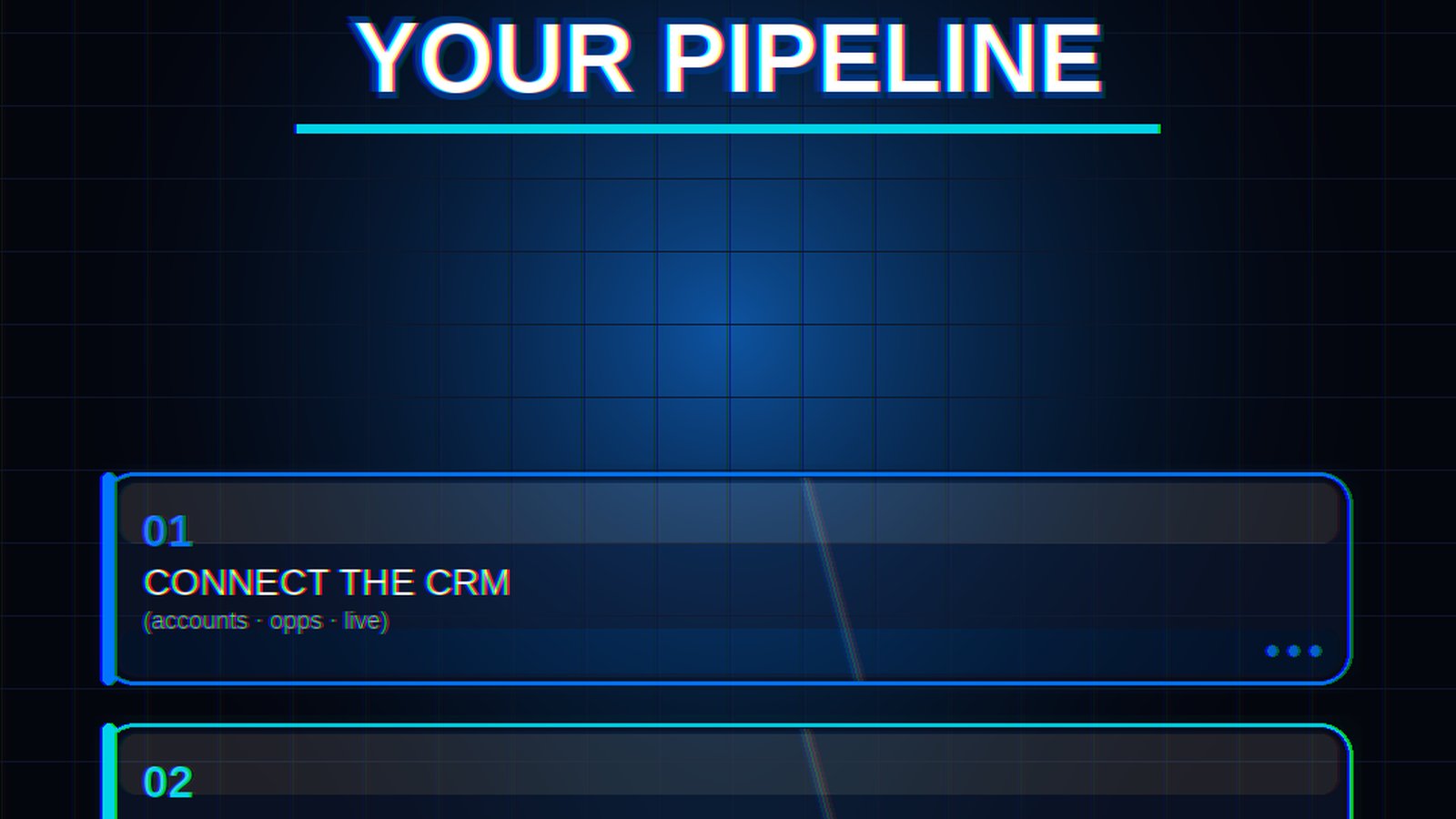
The three-step habit (connect · ask · run)
Here is the version I teach in corporate AI training—narrow enough that a sales lead or RevOps partner can run it this month.
1. Connect the CRM (once, with least privilege)
Admin enables the connector. Sellers sign in with their own CRM credentials. The AI reads only what that seller can already see—no shared admin export dumped into a group chat “for convenience.” Start with one book of business or one pipeline view. Kill the screenshot default for one recurring question; do not boil the CRM ocean.
2. Ask in plain English
Once the CRM is live in the chat, stop cropping boards. Ask what the stand-up actually needs:
- “Which open opportunities slipped stage this week vs. last, and why?”
- “Prep me for tomorrow’s Acme call—open opp, last activity, unanswered threads, missing stakeholders.”
- “Draft a forecast narrative for deals closing in 14 days; flag coverage gaps.”
Refine in the same thread against live records. Iteration against governed CRM beats a one-shot essay on a PNG.
3. Run the sales skill (with a human gate on writes)
Use prebuilt sales skills—or thin internal playbooks—for morning brief, call prep, deal score / close plan, post-call CRM update, pipeline view, and forecast draft. Let the assistant assemble context and propose changes. Keep the seller (or manager) on the approval gate before stage moves, close-date pushes, or new contacts hit the system of record.
| Screenshot habit | CRM-in-AI habit |
|---|---|
| Crop board → paste → hope | Connect CRM once with seller permissions |
| “Insights from this PNG” | Plain-English questions on live opportunities |
| Private chat that never updates the CRM | Sales skill proposes CRM updates for approval |
| Different pastes, different forecasts | One governed pipeline, many readers |
| Training = clever deal prompts | Training = connect → ask → run the skill |
Why sales teams adopt AI when deals live in the chat
Large enterprises can staff analysts to babysit every pipeline export. Most SMEs cannot. You need one path where an AE or manager can ask a real deal question without waiting for RevOps—and without inventing risk from a truncated screenshot.
Putting CRM inside the AI workspace shrinks the switching tax that kills adoption. Sellers stop choosing between “work in the CRM” and “play with the assistant.” The chat becomes useful because it sees the same opportunities the company already trusts. Review focuses on judgment—stage honesty, close plans, coaching—not which tab someone cropped at 7:41 a.m.
You do not need Salesforce, Claude, and thirty-seven branded skills on day one. You need the habit: connect the CRM, ask in plain English, run the sales skill with a human write-gate. When the next CRM-in-AI plugin ships, the habit stays; only the connector changes.
Teams adopt AI when deals live in the chat—not in another tab.
A 30-day CRM-in-AI sprint (narrow on purpose)
Week 1 — Kill one screenshot loop. Name the workflow (Monday pipeline risk, strategic call prep, Friday forecast). Ban PNG pastes for that workflow only. Owner = the manager who runs the meeting.
Week 2 — Connect and ask. Wire the CRM connector with least privilege for a pilot pod. Write three standing questions. Measure how often answers still need a manual export.
Week 3 — Sales skill + write gate. Turn on brief / prep / pipeline / update skills (or internal playbooks). Require human approval before any CRM write. Fix permissions and field gaps—not the tool zoo.
Week 4 — Train the floor, not the novelty. Use corporate AI training to lock the punchline: teams adopt AI when deals live in the chat—not in another tab. Keep the workflow that stuck; drop the rest.
Soft next step
If your organization already bought AI seats and still watches pipeline coaching happen against screenshots, the gap is usually CRM context in the workspace—not another model bake-off. I am Nathan Graham, founder of Synthetic Echo—Toronto-based · serving Canada & North America. I offer a free discovery call to map which sales workflow deserves a connect → ask → run path first, and how training can lock in AI adoption without another abandoned CRM paste. Prioritization conversation—not a free full audit.
Still coaching deals from CRM screenshots?
Nathan Graham helps SMEs put CRM inside the AI workspace—connect, ask, run sales skills with a write-gate—so generative AI for business workflows coaches live pipeline, not a PNG.
Frequently asked questions
Is this the same as Tip 06 live-data advice?
Related shape, different surface. Tip 06 is warehouse/Drive CSV dumps; Tip 11 is sales CRM context inside the AI workspace so sellers stop screenshotting pipeline boards.
Do we need Salesforce and Claude on day one?
No. Start with one connector and one recurring question—Monday pipeline risk, call prep, or Friday forecast. Keep a human approval gate before any CRM writes.
What should corporate AI training teach sellers?
Connect → ask → run the skill. Wire least-privilege CRM access, write standing questions, and require human approval before stage moves or close-date changes hit the system of record.
What should I do next?
Book a free discovery call to map which sales workflow deserves a connect → ask → run path first and how training can lock in AI adoption without another abandoned CRM paste. It is a prioritization conversation, not a free full audit.